There was a research study conducted by Judith Lorber that was completed in order to observe the relationship between the attitudes of surgical patients and the reactions and judgements of hospital staff. The study was completed at a hospital in New York City and it focused on 103 patients who were having elective surgeries and the doctors who performed these surgeries and interacted with these patients.
The Goal:
The goal of the study was to gauge each patients attitudes and beliefs about how they should act in a hospital setting and then observe them to identify if they acted within their beliefs during their stay. Then, the goal was to discuss with physicians and staff regarding each patient and receive evaluations and judgments about the patient’s attitude or behavior.
The Hypothesis:
The researcher’s who completed the study predicted that the patients who believed in “good patient” norms would be the patients who would behave within these norms during their hospital stay, and therefore be identified as a good patient by physicians and staff. On the opposite end, the prediction was that patient’s who did not believe in these norms would not conform to them during their stay, and therefore their behavior would classify them as a “problem” patient in the physician’s eyes.
Results:
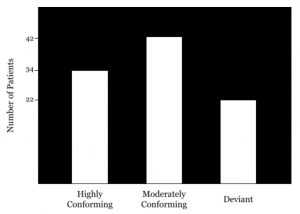
The study found that out of the 103 patients studied, 34 patients were highly conforming, 42 were moderately conforming, and 22 were deviant.
Through examination of the results, it was found that education and age were the largest indicators of conformity vs. deviance in patient attitudes. They found that patients with a lower level of education or patients that are more advanced in age are more likely to be conforming patients, while younger patients with a higher level of education are more likely to have deviant attitudes.
Why?
When patient’s are highly educated — which is becoming more common in our society — they are more likely to ask questions and want deeper information from their doctors about their cases, which can be classified as “deviant” behavior. As society’s education level rises, the gap between medical professionals and laypeople gets smaller (Lorber 216). As this continues, it will be important for physicians to adjust to patients more frequently asking questions and requiring more time from them to provide information. Hopefully, once this becomes the “new norm” for physicians, patients who would previously be described as deviant will become the new average patient. Until then, what does this study mean for patients who ask a lot of questions?